


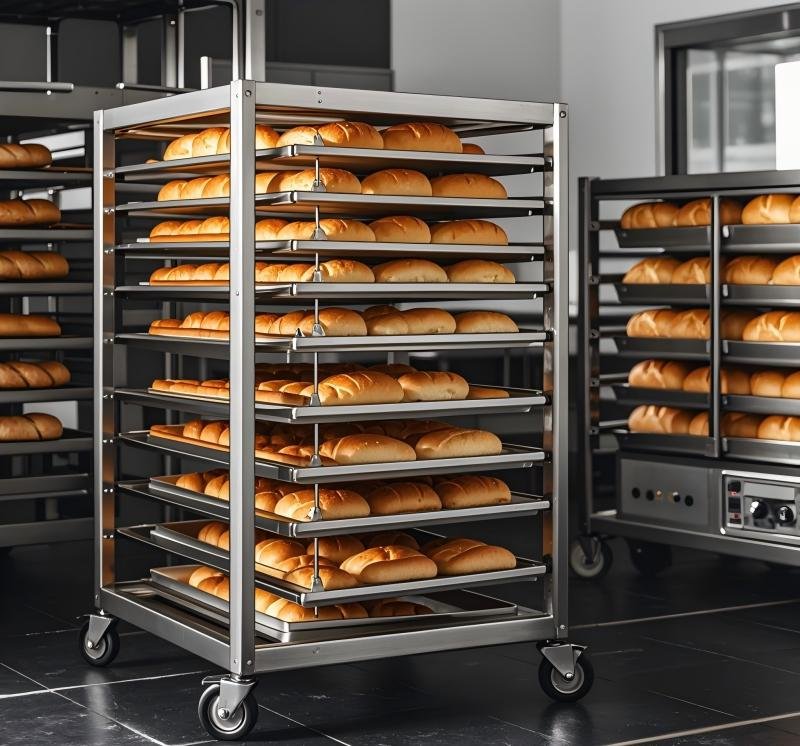
There’s something oddly satisfying about watching trays of golden loaves roll out of the oven perfectly baked. But behind that seamless flow is one unsung hero — the baking trolley. And choosing the right one? That’s where the real magic starts.
Finding the perfect baking trolley for your commercial oven means balancing compatibility, heat resistance, and durability — all while keeping your workflow smooth and efficient. Whether you run a large industrial bakery or a small artisan shop, the right trolley can mean the difference between chaos and consistency.
Let me walk you through what I’ve learned over the years, so you don’t have to make the same costly mistakes I did.
What Are the Types of Commercial Ovens and Their Compatible Heavy-Duty Bread Trolley Designs?
Every oven has its own personality — and your trolley should complement it like a dance partner.
The design of your commercial oven directly impacts the type of industrial baking trolley that will work best — from rotating rack ovens to fixed-deck giants, each needs a trolley tailored to fit both physically and functionally.
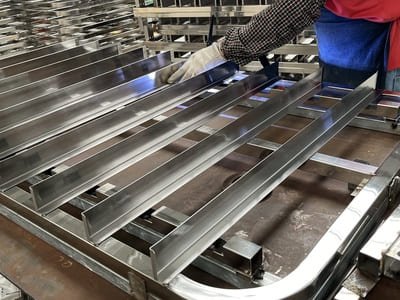
When I first started working in the baking equipment industry, I had no idea how picky ovens could be. One of our early clients ordered 20 trolleys for a deck oven, only to realize none fit because their oven rails weren’t compatible. Ouch. That mistake cost them production time and trust — both hard to earn back.
Let’s break it down:
Common Oven Types & Matching Trolley Rack Designs
| Oven Type | Best Compatible Trolley Type |
|---|---|
| Rotating Rack Oven | Rolling rack for bakery with hook-in mechanism |
| Fixed Deck Oven | Removable tray trolleys or manual loading carts |
| Convection Oven | Standard stainless steel bakery rack |
| Tunnel Oven | Custom bakery trolley designed to sync with belt |
Not sure what type you have? Check your oven’s model manual or talk to the equipment supplier. They usually know which commercial oven trolley designs work best.
How Do You Measure Your Oven for the Perfect Trolley Fit?
Trust me — don’t eyeball it. Been there, done that… had to cut and re-weld a trolley.
To ensure a proper fit, always measure your oven’s interior width, height, and depth — along with rail spacing and entry clearance — before ordering or customizing a baking trolley.
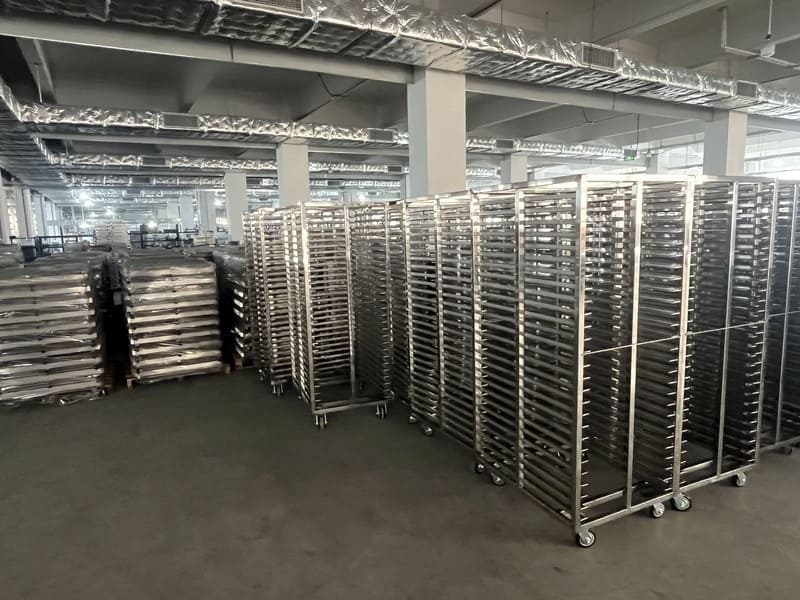
I always carry a worn-out measuring tape in my toolbox. It’s stained with years of coffee and flour dust, but it’s saved me more times than I can count. One time, a client in Vietnam was convinced their oven was 700mm wide. I asked them to re-measure — turns out, it was 680mm. That tiny 20mm made a huge difference, especially when you’re trying to fit a heavy-duty bread trolley inside.
Here’s a quick checklist:
- Interior oven width, height, and depth
- Clearance between rails (if using side rails)
- Oven door opening size
- Wheel clearance (especially for baking rack with wheels)
Pro Tip: If your oven has uneven heat distribution, request a custom bakery trolley that helps optimize airflow. Your bread will thank you.
Fixed Rack vs. Removable Tray Design: What’s Right for You?
Ah, the eternal debate — one I’ve had with many bakery owners over coffee and croissants.
Fixed rack trolleys offer speed and simplicity, while removable tray trolleys allow more flexibility and easier cleaning — the best choice depends on your production scale and sanitation requirements.
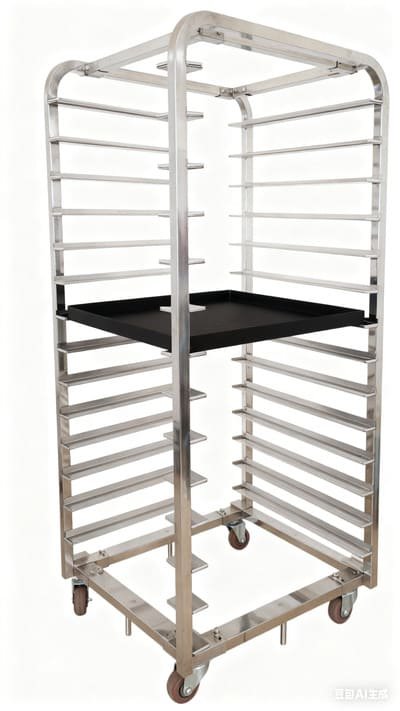
At one point, I worked with a high-end French bakery that swore by removable tray racks. Why? They baked delicate sourdoughs and didn’t want to risk damaging them during unloading. Meanwhile, a factory-style sandwich bread producer I visited in Indonesia stuck with fixed rack trolleys — speed and volume were their priority.
Let’s compare:
| Feature | Fixed Rack Design | Removable Tray Design |
|---|---|---|
| Cleaning | Harder to clean | Easier to wash each tray separately |
| Tray Compatibility | Trays are permanently welded | Interchangeable — use different types |
| Efficiency | Faster loading/unloading | Slightly slower, but more versatile |
| Cost | More affordable | Typically higher initial cost |
In short: If you’re after volume and speed, go fixed. If you need cleanliness and flexibility, go removable. Simple as that.
Why Do Heat Resistance and Wheel Quality Matter in Oven Trolleys?
If you’ve ever had a wheel melt mid-shift, you’ll know why this part matters.
High heat resistance ensures trolley durability in oven environments, while quality wheels provide smooth mobility, stability, and reduce injury risk during fast-paced production.
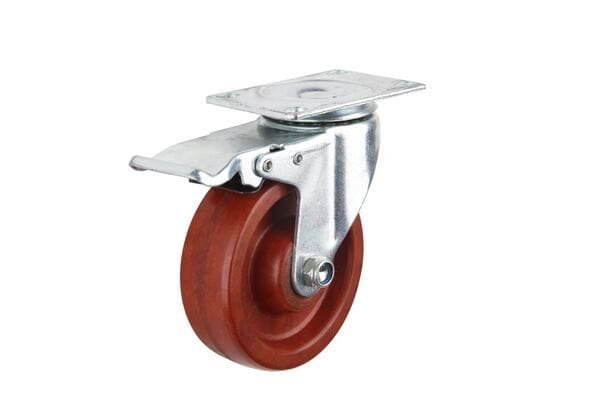
I once had a customer call me in a panic — their trolley wheels had literally cracked after two weeks of use. Turns out, they were using low-grade plastic casters in a 260°C oven. That moment taught me the importance of investing in heat-resistant baking cart wheels with proper temperature ratings.
Here’s what I recommend:
Look for This in Your Trolley Wheels
- Heat resistance: At least 280°C for oven use
- Ball-bearing swivel castors: For smooth turning
- Non-marking material: No streaks on bakery floors
- Locking mechanism: Prevents rolling accidents
And don’t forget the structure. A durable baking equipment frame should use fully welded joints — not just bolts — for maximum strength.
Where Can You Buy High-Quality Baking Trolleys for Commercial Use?
Of course, I’d love for you to check out what we offer at TM Baking — but even if you don’t, here’s what to look for.
Choose a supplier who understands your workflow, offers customization, and uses high-grade materials like food-safe stainless steel — avoid off-the-shelf trolleys that don’t fit your real needs.
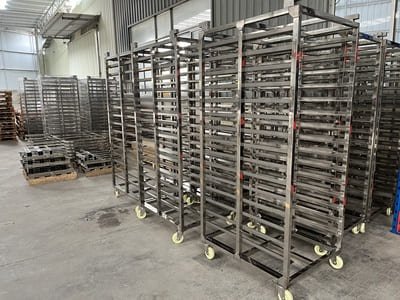
Back when I was just starting out, I used to buy second-hand trolleys from local markets. They looked sturdy at first, but within months, the welds gave out or rust set in. That experience inspired me to build something better — a stainless steel bakery rack that lasts through the rush of breakfast prep and beyond.
Here’s how to vet a supplier:
- Do they offer custom bakery trolley sizing?
- Do they test for heat and load resistance?
- Are their materials food-grade and easy to clean?
- Do they provide safe international packaging and delivery?
A good supplier will care not just about the product — but about what it helps you produce: amazing bread, served hot and perfect, every time.
Conclusion
Choosing the right industrial baking trolley isn’t just about metal and wheels — it’s about making your bakery run smoother, safer, and more efficiently. The next time you open your oven door and see evenly baked bread rolling toward you on a shiny, sturdy rack, you’ll know you made the right call.
So take a moment, grab your measuring tape, and choose a trolley that truly works for your bakery — your team (and your bread) deserve it.